 So the reputable Jeremy Richey over at Moon in the Gutter is hosting a blog-a-thon dedicated entirely to, depending on who you talk to, everyone favourite or least favourite contemporary auteur Paul Thomas Anderson. Being one of my favourite filmmakers I will, of course, be participating. So swing 'round Moon in the Gutter from September 13th to 19th and check out everyone's diverse take on this fascinating filmmaker.
Monday, August 30, 2010
A Blog-a-Thon to Remember
So the reputable Jeremy Richey over at Moon in the Gutter is hosting a blog-a-thon dedicated entirely to, depending on who you talk to, everyone favourite or least favourite contemporary auteur Paul Thomas Anderson. Being one of my favourite filmmakers I will, of course, be participating. So swing 'round Moon in the Gutter from September 13th to 19th and check out everyone's diverse take on this fascinating filmmaker.

The Expendables (3 out of 5)
 There’s no excuse for The Expendables but then again, why should there have to be? This is a film that bathes in the excesses of its forefathers; a throwback to the 80s heyday of macho action heroes destroying everything in their sight in order to protect the girl/save the innocents/bring down the bad guy. You know the drill: no building left standing, no vehicle left uncharred, no faceless solider left standing, no piece of grass left unsinged. I can’t, in any sort of good conscience, recommend it; it’s too shallow, too broad, too cheap looking, not witty enough and, as a throwback, lacks the kind of personality that made its referents so special, but anyone who sees it will, I suspect, be getting their money’s worth.
Sylvester Stallone (who also directs and co-writes) stars as Barney Ross, the main badass in a team of ragtag elite fighters. They’re like the A-Team except, since they are all played by discernible action movie heroes of different varieties (Jason Statham, Jet Li, Mickey Rourke, Dolph Lundgren) Stallone doesn’t rely on providing generic types so much as simply coasts on the presence of his stacked line-up. That’s fair, it’s like trading in one superficiality for another but Stallone uses his team as a reason to coast: presence only goes so far if you don’t get to caring about the hero your tagging along with.
Thus the film coasts lightly on the surface, afraid to ever delve deeper into any emotional interest lest it get in the way of blowing stuff up. It’s never really explained how The Expendables know each other, who pays their bills, and just whether or not what they are doing is technically legal. In fact, the only time we ever do get a glance at anything genuinely human is when Mickey Rourke, as the old dog who mans the HQ, conveys a painful story from his past and runs away with the movie.
The mission, given to Stallone by a no-nonsense Bruce Willis, after being passed on by Arnold Schwarzenegger in one of the films true guilty pleasure scenes, is to travel to a remote Latin American country and rid it of, oh I don’t know, anyone who doesn’t look like a friend to the U.S.? Ruling over the country is an evil dictator who is secretly at the mercy of an evil American ex-agent played by Eric Roberts, who, as far as villains go, is basically a stock character who stands around with a menacing scowl because, you know, these things need villains. It’s never quite explained what Robert’s purpose is, why he holds command over the dictator or what he wants to achieve but hey, his number one heavy is played by “Stone Cold” Steve Austin. You see how it works?
So the team visit the country, case it, meet a young beauty who is both a revolutionary and the general’s daughter, and narrowly escape after they are detected. But just to show those slimy South Americans they blow the hell out of their harbour via airplane machine guns. What they actually discover when there is a mystery to me, but whatever it is, it prompts them to return with some serious firepower and lay waste to everything in their sights, all in order to, I guess, save the girl while, along the way, just for flavour, one of them crosses over onto the other team’s side.
What more description of The Expendables does one need? A lot of things go boom, while little plot gets in the way. The film is funny but not nearly funny enough and, as was the case with Stallone’s Rambo, the violence, at times, is far too serious to be taken as entertainment. At other times, when CGI is employed the film looks cheap: the bloodshed reminiscent circa 1998 arcade violence.
And yet there is a certain sense of freewheeling fun on display here. One must nod in admiration at a film that is willing to pull out all the stops and not apologize for it for better or worse and the film, for the most part, features action that feels more or less authentic. As a throwback the film undershoots its target but as an excessive display of recognizable faces laying waste to everything in their path well, what more could you want?
Wednesday, August 25, 2010
Scott Pilgim Vs. The World (5 out of 5)
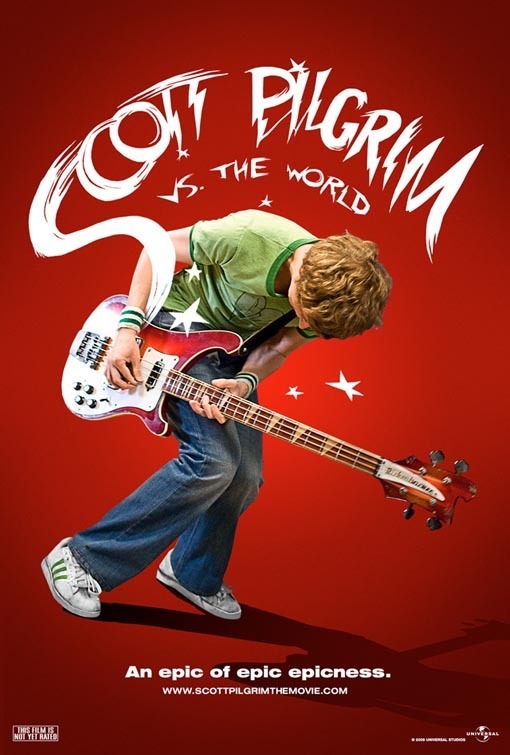 Scott Pilgrim vs. the World is awesome, which begs the questions, as raised by Stephanie Zacharek in her negative review of Inception, if that is enough? A better response may be: so what? In the grand scheme of film and culture and art does awesome really amount to anything but a two hour confectionery that, like lightening, strikes with swift brilliant force and then is gone? It’s maybe the very problem that gnaws at all classical minded film critics as they forge on into the future. I guess, if we are to rate Scott Pilgrim in a vacuum, sealed off from the last hundred, or even ten, years of film history, the answer is that yes indeed, it’s awesomeness is truly enough, or at least under the (maybe sad?) realization that if most, if not all, films are becoming no more than flashes of noise and colour than they might as well at least strive to be cute and hip and funny and hurdle images at the screen that are just a little unlike anything we’ve ever seen before. So, there you go.
The story revolves around Scott Pilgrim (Michael Cera) a geeky bass player from Toronto who has just hooked up with a 17 year old Asian girl, Knives Chau, who also doubles as Pilgrim’s number one fan. His band is called Sex Bah Bomb and they play local gigs hoping that there will be at least one non-band member in attendance that hopes they won’t suck.
Then Scott lays eyes on the Technicolor haired Ramona Flowers (Mary Elizabeth Winstead) and its love at first sight. He constantly dreams about her, stalks her at parties, ignores Knives who is so infatuated that she hardly notices and orders packages on Amazon just to fill the waste basket when he finds out she’s the delivery girl.
Eventually, Ramona agrees to go out with Scott but he soon finds that there’s a catch. She moved to Toronto from the U.S. in order to escape her past and rediscover herself. As it turns out, she is running from seven evil exes who have all teamed together into one league in order to fight Scott Pilgrim to the death. This makes up most of the body of the film despite the fact that a fight to the death is a fight to the death and an evil ex is an evil ex and once you’ve seen two or three you’ve seen about as many as you probably will ever need to.
The story isn’t a whole lot more complex than that. What makes it interesting is that its director Edgar Wright (Shaun of the Dead, Hot Fuzz) takes great, excessive pains in order to make this material actually feel like a video game or a graphic novel. Scott Pilgrim vs. the World, like Speed Racer before it, is one of the few films that know how to use special effects for all they are worth, creating, not so much a film, as, for better or worse, an experience that completely immerses you in it’s spell. Scott Pilgrim is a lot of things. Boring it is not.
If there’s any problem, it’s that Wright does too good of a job. He spends so much time on visual details: the split screens, the accompanying words that go with sounds like the phone ringing or the door knocking, the video game aesthetics, the bright lights and so on, that he kind of forgets to do anything with the material going on underneath.
Thankfully Wright is in the company of good stars who manages to make the material funny and sweet and give it a bit of a human element that can at least propel it for two hours. Michael Cera does his typical loveable goofball routine, Winstead is perky and cute while still always being one of those girls who can never quite be trusted to still be there the next day, Kieran Culkin plays deadpan of Scott’s gay roommate and gets away with it and Anna Kendrick shows up for a few scenes of quirky, fast talking funny business.
But a film like this doesn’t exist as its parts. It’s a whole package that you either let in or reject outright. It’s so busy that it doesn’t have much time for character or plot, but what a lightshow it provides. In the end, Wright has a good eye for visual comedy and Cera is as endearing a presence as any but the film ultimately rises and falls on just how spectacular and inventive it can be. It is spectacular. It is inventive. It’s also like nothing you’ve probably ever seen. Sometimes, that’s all it takes.
The Other Guys (1.5 out of 5)
 There’s a moment in The Other Guys that is just about the funniest thing Will Ferrell has every done. It proves that Ferrell has all the ability to be a brilliant subtle character comic but none of the good sense to follow through with it. The Other Guys is instead a constant parade of stock Will Ferrellisms: breaking out into pimp talk, yelling nonsense like a madman, making forced pop culture references and, as is his speciality, conducting himself like a full grown moron with the subtlety of a jackhammer.
And yet there’s that one scene, denying us all the promise Will Ferrell has been denying us for years. It involves the star standing in the doorway of a ballet school. He’s just finished yelling something nonsensical. The dance instructor tells him to go away. He pauses, stares, turns and walks away with a strange and perfect mix of force and idiocy and for one moment so brief that you blink and you miss it, Will Ferrell has become an actual character.
Character is exactly what has been lacking form every Ferrell comedy since Talladega Nights. It’s not so much that we expect much from Ferrell and his director/collaborator Adam McKay anymore, as much as it is that they drag good people down with them. In this case it’s Mark Wahlberg who can be a very funny actor but here is given nothing to do but play off of Ferrell's doofus naif, which basically comes down to a lot of frustration, yelling, and telling his partner that he just doesn’t like him very much.
Gamble (Ferrell) and Hoitz (Wahlberg) are mismatched police partners to say the least. Gamble is tall, straight-laced, always dawns his oversized spectacles and would rather work a calculator than a drug bust. So clueless is this guy that when his co-workers convince him that it’s a regular office practice to fire your gun off into the ceiling he ends up being issued a wooden gun as a result.
Hoitz on the other hand is fiery and ready for action. He used to be a hotshot but got transferred and stuck with Gamble because of an incident that gets a chuckle the first time and then get’s beaten into the growd as it becomes one of the plots many frequent punch lines. After the two top cops (Samuel L. Jackson and Dwayne Johnson) get taken off the job in one of the films few big laughs, Hoitz sees an opportunity and must convince a reluctant Gamble to get out from behind the desk and onto the streets.
There’s no point talking much about what kind of case Gamble and Hoitz stumble onto because the entire film is essentially a collection of set ups for Wahlberg to scream at Ferrell and Ferrell to say something stupid in response. Sometimes the exchanges manage to find something halfway amusing to run with, but more often than not they are just superfluous flashes of nothing in particular. Ferrell talks about his days as a pimp, his sexual escapades with his wife, how a school of tuna would defeat a lion who tried to capture them and you know how it goes.
None of this does anything to build into comedic characters or a some sort of clever plot. Instead it just sits on the screen, does noting, proves nothing, contributes nothing and then disappears only to be followed up by the same bit of business. The chief is played by Michael Keaton who, once, amusingly quotes a TLC song and then denies and then does it again and again and again. He also works a second job at Bed, Bath and Beyond where he gives a pep talk about the new shipment of rugs. Characters rarely ever run deeper than that.
None of this does anything to build into comedic characters or a some sort of clever plot. Instead it just sits on the screen, does noting, proves nothing, contributes nothing and then disappears only to be followed up by the same bit of business. The chief is played by Michael Keaton who, once, amusingly quotes a TLC song and then denies and then does it again and again and again. He also works a second job at Bed, Bath and Beyond where he gives a pep talk about the new shipment of rugs. Characters rarely ever run deeper than that.
None of this would matter if the punch lines were funny. However they aren’t. They aren’t even halfway towards clever. Part of the thing that made Talladega Nights work so well is that it had the clear idea that it wanted to be a parody and shot for that. The Other Guys has no such conviction. Instead of approaching this material with the keen eye of a spoofster, McKay and his crew trample forward with the laden hand of someone who can’t be bothered to think up a decent punch line, thinking that maybe half-hearted jokes will maybe get funnier with every time that they are repeated. It’s a shame, Will Ferrell is a talented guy and can be a compelling character actor. I just desperately pray that he will soon muster the sense enough to stop making Will Ferrell movies already!
Friday, August 20, 2010
A Step Forward in What Direction?
 With the continuing advancement of technology those purists keep whining that human beings are getting lazier and lazier. Wall-E may have been a cute and magic cartoon but you could see the parallels on display there. Similarly, whether that assertion is correct or not, it seems that people who read film criticism are getting lazier too. I'll admit it, I'm one of them. Right now I'm reading a 700 page volume entitled American Film Criticism. It's a collection of the very best people who ever wrote about film putting their very best writing forward from the dawn of cinema right up to today. And so far, I've been reading every word of it. I've been reading every word of it for, oh I don't know, six months and I'm around Page 400. It's tough.
See, I'm now a part of a generation (although maybe once removed) in which film criticism is reduced to soundbites. I've indulged. Back in the day you picked up a newspaper because it had your favourite critic and you read everything they had to say because they wrote well and were generally more interesting than the movies they wrote about. Now personality is, (somewhat/mostly?) gone. Instead of reading full pieces by one or two favourite critics we read little snippets on Rotten Tomatoes or MetaCritic of every critic just to get a flavour. It has it's benefits. It is certainly nice to get a wide array of opinions instead of been burdened to just a select few and it is possible to read the entire review from RT if you come across something you like. It also helps those whose only goal in reading film criticism is to know if people generally like it or not in order to decide if it's worth seeing.
Now criticism has gotten even simpler: Why read through all the snippets when RT will summarize them all in a couple sentences for you. Although I am fully aware that they have provided 'Consensus" for some time, I've just recently been paying attention to it. Now I can log on to the main page, see the percentage rating beside the list of new releases on the left, roll my mouse over top the name and read quickly what the overall just of the reviews are about. All without leaving that one page.
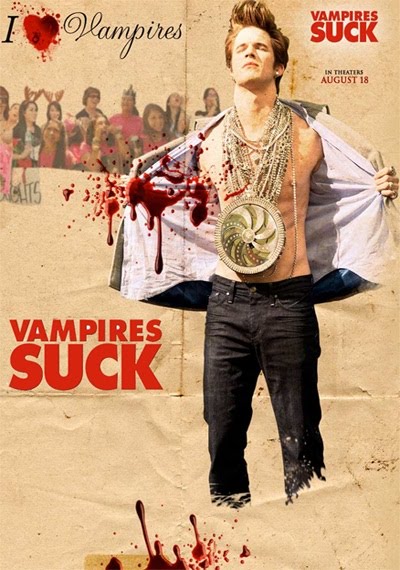
Of course I could go on about how, as a writer, by favourite thing about reviews is not knowing what people think about the movies as much as reading great writing, but that's not the point and indeed it was a long build-up to get to my otherwise nothing point, which is that today I came across a perplexing Consensus on RT. It was for the new Jason Fiedberg/Aaron Seltzer (man it hurts to say) film Vampires Suck. I haven't seen it, but considering that I've sworn to never pay another cent to watch anything those two morons ever put their name on, my hopes aren't high. Right now it's sitting at 6% rating with 1 person out of 30 actually finding something to like. But now look at the Consensus: "Witlessly broad and utterly devoid of laughs, Vampires Suck represents a slight step forward for the Friedberg-Seltzer team."
What's going on here? If it's witlessly broad and devoid of laughs, what is it stepping forward from, killing Jews? Is it really saying, holy crap I can't believe one person actually liked this, that's the best yet or is it saying that this one feels less like getting murdered than just getting raped? Whatever it is it doesn't make sense. Can't we just call a dog a dog? I know a couple million people have read The Secret and want to look at the glass as being half full but really, a glass doesn't even factor into the equation when it comes to these filmmakers. I have no real point here other than to scratch my head and maybe laugh at myself for even being bothered to care.
But maybe there is something here. Armond White just told Slash Film that he thought Roger Ebert more or less ruined film criticism and, although I haven't listened to his reasoning, I assume it's because Ebert opened up criticism to a more mainstream audience. It made, so to speak, film geekery cool and stripped criticism of it's intelligence. I don't agree with that logic but in a sense, showed film loves that they could take criticism away from the intellectuals and give back to the moviegoers who could just as easily wage their own Siskel and Ebert style debates at home.
If that is true (and again, I don't think it is in the sense that it ruined film criticism) than what do we make of the whole of criticism being reduced to one sentence bites of information, especially when they seem widely implausible (based on this example of course, I can't qualify that statement with any other proof). Is this helpful? Is this criticism? Is that, ultimately, what we want?
Discuss.
Wednesday, August 18, 2010
One Minute Review: Black Dynamite (3.5 out of 5)
 The problem with Black Dynamite is that it doesn't quite know whether it is a spoof or an homage and so it fails at both. How couldn't it? After all, as an homage it comes up short because what made Blaxpoltation so popular in the first place is that it had no point of reference other than itself. It didn't pay tribute to anything, wasn't inspired by anything and therefore played by it's own rules. As tribute, Black Dynamite has knowledge as it's enemy. It knows what Blaxplotation became, what it stood for, how it worked and so on. In this case, knowledge certainly isn't power. As a spoof it doesn't work because Blaxplotation was so off the wall that it, in many cases, played like it's own spoof. Black Dynamite is thus best when it is playing it perfectly straight because it combines the best of both spoof and tribute and manages to feel, in spite of itself, like an actual movie and can be quite funny. Here's a perfect example:
The film begins failing when it goes into full on Airplane style spoof mode in which it tries too hard and achieves too little. If nothing more though, Black Dynamite acts as an amusing reminder of why we should go back and rediscover all those bBaxplotion classics once again.
Sunday, August 15, 2010
Mike's DVD Haul
This will be my last DVD Haul for a while. Sure I'll buy a DVD here and there but I don't expect to be going out and buying mass amounts of DVDs any time soon. I've got to save money and such. It ain't cheap living in Toronto you know. So anyway, I'm glad that people have been following along and like seeing what I'm picking up and I'm glad Travis came up with this idea over at The Movie Encyclopedia so that I could steal it from him. Although in his last post he put up a picture of his DVD shelf. Always two steps ahead I guess.
 In the same vein as The Unbearable Lightness of Being and Last Tango in Paris, Louis Malle's Damage is an erotic tale that was praised for actually being about eroticism instead of just going for titillation. I haven't seen it but this is considered one of Malle's better American films.
 If there's one thing I love the way I love movies it's stand-up comedy. One of those comedians I love is Patton Oswalt. Know for his work on sitcom King of Queens and the voice of Remy the rat in Ratatouille, Oswalt is considered to be part of the "Alternative" comedy movement (whatever that means) alongside David Cross and the routinely unfunny Brian Posehn. I haven't seen this set yet but have rarely ever found Oswalt unfunny.
 More Louis Malle. Malle made three films, Murmur of the Heart, Lacombe, Lucien and Au Revior Les Enfants which were all coming of age tales about kids forced into growing up under unfortunate circumstances. These films are not as unhinged as Malle's French New Wave films but are very personal and introspective experiences nonetheless.

 I don't know if anyone would buy this for Troll. It's kind of like a special freebie that you get for buying Troll 2, which, if you don't know (for shame) has become famous for being one of the worst movies ever made. So bad is Troll 2 in fact that it is, in a twisted sort of way, kind of a work of art. It's so naive in it's badness, trying so hard to be good that there is just no way it could have ever worked. From the horrible acting to the laughable costumes and special effects to the nonsensical dialogue, this movie is an absolute classic.
In the same vein as The Unbearable Lightness of Being and Last Tango in Paris, Louis Malle's Damage is an erotic tale that was praised for actually being about eroticism instead of just going for titillation. I haven't seen it but this is considered one of Malle's better American films. If there's one thing I love the way I love movies it's stand-up comedy. One of those comedians I love is Patton Oswalt. Know for his work on sitcom King of Queens and the voice of Remy the rat in Ratatouille, Oswalt is considered to be part of the "Alternative" comedy movement (whatever that means) alongside David Cross and the routinely unfunny Brian Posehn. I haven't seen this set yet but have rarely ever found Oswalt unfunny.
 More Louis Malle. Malle made three films, Murmur of the Heart, Lacombe, Lucien and Au Revior Les Enfants which were all coming of age tales about kids forced into growing up under unfortunate circumstances. These films are not as unhinged as Malle's French New Wave films but are very personal and introspective experiences nonetheless.
Sometimes when I see a film it reminds me of how good a previous film was and how I want to see that one again. Mission Impossible 3 made me go out and buy Mission Impossible 2, Fast and the Furious 3 made me go out and buy the first 2 and now Inception made me want to go back and get The Prestige, which essentially tells the same story and explores the same ideas but with more clarity and intelligence and less boom boom.
I've also got a copy of Jean-Pierre Melville's Le Samurai on the way but it didn't get here in time to make the cut. Oh well, it's a great film anyway.
Subscribe to:
Posts (Atom)


