Showing posts with label John Hughes. Show all posts

Monday, June 21, 2010

Realism

Let's have a debate. A couple months ago I wrote a piece on the Don't You Forget About Me, a documentary in which a bunch of young Canadian filmmakers travel to Chicago in hopes of getting an interview with John Hughes not long before his death. The piece ultimately ended up a reflection on what constitutes realism in film. Check it out here. Essentially, to repeat myself, film realism is not the same as reality because, since the camera is a recorder of literal events, realism in film comes down to what can be considered believable. In that sense The Dark Knight, despite taking place in a fictitious city with superheros and villains, is a more realistic film than say, a satire like Kick-Ass, which takes place in the real world. The Dark Knight creates a world that is both fully believable as itself and that takes itself seriously as a real place. We don't quite know any place on Earth like Gotham City or anyone quite like Batman or The Joker, but they mimic qualities that we associate with real people, they mirror our beliefs and what they stand for makes sense in a logical human world.

That's film realism. To repeat once again, John Hughes' movies aren't so much realistic in that they present a portrait of what being a teenager is really like but that they create an idealized portrait of how teenagers would like to see themselves and they deal with emotions that aren't outside of human grasp even if they are simplified flights of fancy when juxtaposed against the messy, complicated realism of everyday life. As I've said before to the age old question of whether life imitates art or art imitates life: it's a two-way street, we'd like to think we talk like they do in the movies and the movies would like to think they talk like we do in real life.

Even a film that appears to be dealing in realism like Gus Van Sant's Elephant with it's unprofessional teen actors, it's basis on real events, it's reliance on anti-climax, etc, is not so much a realistic portrait because of it's deliberate artistry. Elephant is a film that translates the banal into poetic-tragedy. It understand what it is like to exist in a moment when something is occurring that you can't quite grasp, but I suspect it is more a reflection of the inherent meaning of Columbine than a realistic portrayal of what it felt like to be there, in that moment, as these events were occurring.

In reality, realism isn't much desired in films. As much as we critics pine for it and accuse filmmakers for not giving it to us, what we really want is believability, even in the face of insurmountable perposterousness. A movie, anyway, doesn't need to be believable to be successful, but it needs to at least believe in itself, which, when you think about it, is kind of the same thing.

So what do you think, is there a successful (or any) film out there that is an honest representation of day-to-day reality? Let's throw some titles around and debate this. I believe I know one film that successfully depicts realism (which is what inspired this) but I'll wait to weigh in in the comments after seeing what people come up with.

Monday, March 8, 2010

And the Oscar Went To...

The Oscars are over. What will Nataniel R write about now over at Film Experience considering he was averaging around an ungodly 3-5 Oscars posts a day? So what did I think of the Oscars? They were okay. Some things worked, some didn't. There was a lack of drama except for one interrupted acceptance speech for best short documentary. That said, I just wanted to share a couple of random observations I made throughout the night.
  • Steven Martin and Alec Baldwin are funny guys. Hopefully though, if there is ever a pair of hosts again they can have dialogue that sounds more like a routine and not an improv at Second City. The picture of them backstage in a couple's Snuggie was a huge laugh though, as was Martin's comments about writing Geoffrey Fletcher's speech.

  • Not only was Neil Patrick Harris' opening song completely unglamourous and mostly unfunny, but what was with the lighting in the audience? The camera was cutting to people in the darkness as he was singing about them.

  • Robert Downey Jr. could make a funeral funny. Best presenter of the night.

  • Sean Penn managed to go the whole night without kicking or punching anyone but still couldn't manage a coherent introduction to the Best Actress nominees. *Update* I haven't even published this post and I'm eating my own words.

  • Jeff Bridges is a rare kind of star: he dedicated his Best Actor award to his late parents, he's been in a marriage for over 30 years, he's acting has never been undermined, to my knowledge, by any personal drama and he's a heck of a great actor on top of it. Did his speech ramble on? Sure it did, but he deserved the moment.

  • Tyler Perry: "I'm on stage at the Oscars. I better make the most of it because it probably won't happen again." My thoughts exactly.

  • I don't know what's worse, a pointless montage paying homage to horror films or the fact that it included scenes from Twilight. And to think, this is why no original songs were performed.

  • Although it was an impressive display of physical acrobatics, Mad Hatter said it: if I wanted to watch America's Next Dance Crew, I could have changed the channel to it. I think it's safe to say we can thank Adam Shankman for that number.

  • Precious won Best Adapted Screenplay. I picked Up in the Air to win. I guess I learned a valuable lesson: don't pick the better film to win because it probably won't.

  • Mo'Nique's acceptance speech was one of the best and most heartfelt. She thanked Hatti McDaniel, the first black actress to win an award for Gone With the Wind, for going through when she had to go through so she wouldn't have to. Back then awards were given out during dinner and McDaniel was forced to sit at a table by herself.

  • I don't know if she deserved to win or not, but Sandra Bullock's speech was good too.

  • Thinking about Best Actress, Oprah almost had me sold on Gabby Sidibe and then I realized that she probably won't have much of a career after Precious because, not to sound course or anything but, she's can't really play anything but fat black girls.

  • Did you see that moment before she read the winner when Barbara Streisand said "It's finally happened," giving Lee Daniels just one second of hope?

  • Kathryn Bigelow is 58 and still looks better than most of the young stars in attendance. Good for her. Also nice to see her take home the big awards as she hasn't exactly been the kind of filmmaker you'd expect to make award winning films in the past.

  • I was strangely unmoved by the John Hughes tribute. The montage of his work was weak and, outside of Planes, Trains, and Automobiles and Sixteen Candles I've never found his work anything more than simply entertaining and this tribute didn't do anything to change my mind about him, or his deserving a separate honour all to himself
  • Speaking of honouring late celebrities: where the hell was Farah Fawcett in the montage?

  • Ben Stiller bounced back this year after his tasteless parody of Joaquin Phoenix last year. He played the Avatar get-up perfectly, as a man who looked like a jackass and knew it. That said, where was all the other big comic talent like Will Farrell and Jack Black? Did Shankman sacrifice them for Taylor Lautner and Kristien Stewart?

  • Next year, how about going back to five Best Picture nominations? That's all anyone really needs.
  • Why is Pedro Almodovar introducing a category that he clearly deserved to be nominated in?

  • Speaking of Best Foreign Film: do voters just pull names out of a hat for this category? Remember a few years ago when Pan's Labyrinth won every award it was nominated for except Best Foreign Film? I think Almodovar got the shaft that year too.

  • While we are on this topic: why does Quintin Tarantino feel the need to start yelling into the mic at every awards show? He did it at the Grammys and now he has done it here too.

  • I long for a year when Jason Reitman will actually be the frontrunner. He really deserves some wins.

  • I got three of my predictions wrong. Not bad.
With that said, I noticed two big Celebrity Connections last night. Check 'em out:


Could T-Bone Burnett really just be James Cameron in disguise? You Decide.


Could Hurt Locker writer Mark Boal be Jason Reitman in disguise? You Decide


Wednesday, February 17, 2010

The John Hughes Tribute


Deadline Hollywood got a scoop today that there is a separate John Hughes tribute being planned for this year's Oscars apart from the usual name and picture as part of a collage thing that the Oscars usually do.

This is all fine and dandy and touching and all that stuff because, as I wrote last week when I posted about Hughes, his films had an enormous impact and his death came suddenly and without warning. However, despite his impact, I'm not so sure Hughes was good enough a filmmaker to deserve his own separate tribute, especially when Robert Altman, Heath Ledger or Eric Rohmer, just to use random examples, only got the in memoriam treatment come Oscar time.

I understand that some of the Oscar writers and producers and both hosts Steve Martin and Alec Baldwin worked with Hughes before, but I don't know, this whole thing reeks of desperation: finding any means necessary to up Oscar ratings.

It also sets a strange precedent for the future of Oscar telecasts by opening up the question: at what point is someone special enough to deserve their own separate tribute after death and just who decides who meets the criteria?

Thursday, February 11, 2010

John Hughes


I just finished watching Don't you Forget About Me a documentary about a group of Canadian filmmakers who head for Chicago in order to snag a rare interview from iconic but reclusive filmmaker John Hughes who more or less disappeared from filmmaking in the late 90s and wasn't heard from again until his unexpected death last year.

The documentary itself isn't a great one; it really has no background on Hughes as a person or a filmmaker, it only focuses on his 80s teen comedy work neglecting his best film Planes, Trains and Automobiles or his later, lesser quality screenwriting efforts under a pseudonym, and of course, ends in anti-climax as Hughes does not accept to be interviewed.

However, one thing about the film struck me. The weight of the material comes from a combination of interviews with some of his actors (though Molly Ringwald is understandably absent), some other filmmakers who he inspired (Kevin Smith, Jason Reitman), critic and fellow Chicagonians Roger Ebert and Richard Reoper and a bunch of high school kinds in an effort to show that contemporary teenage comedies are vapid and shallow and don't reflect what it is really like to be a teenager. "I've never had sex with a pie," one kid says. "But I've defiantly skipped class before."

Smith, Reitman and Howard Deutch (who directed Pretty in Pink and Some Kind of Wonderful) along with all the kids interviewed throw the term realism around a lot in relation to Hughes' work. They say that Hughes was so influential because you could go to his movies on a Friday night and see yourself projected up on that screen. Some people claim they knew and were friends kids like the ones in Hughes' movies, and no one has ever gotten that formula quite right again.


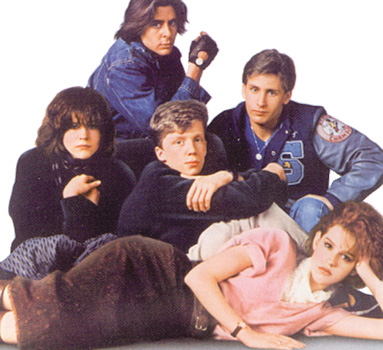
I'll agree with the second point: no one indeed has ever gotten it quite right again (although I think there is may be more truth to some of the more tender moments in American Pie than the kid in question is letting on). Indeed, teenage comedies over the years have become shallow, juvenile, gross and stupid and do not reflect what it is truly like to be a teenager in the midst of growing up. There aren't movies about kids just hanging out anymore, having fun, wandering aimlessly, trying to find themselves when they can muster up the energy to do so, and so on. That was Hughes at his best within those teen films. A lot of people in the documentary say things like The Breakfast Club could never have been made today or people like Molly Ringwald could never be stars: it was too talky, too boring and she was too average, too ordinary; he persona didn't come with enough baggage to be flaunted in public. They are probably right.

All that is fine and dandy and, most of all, true. But I wonder just how much closer John Hughes actually got to reality than any other filmmaker ever does. My high school experience never mimicked anything like what is depicted in those films and this brings me to my reservations about using the word reality in regards to film.

Simply put, realism in movies doesn't exist. Critics talk about it all the time. Andre Bazin constantly touted realism in film and dismissed anything that came with even the slightest hint of artificiality (Jim Emerson posted a good article on this topic over at Scanners earlier today).

However, the realism that Andre Bazin and other critics talk about is not the realism of the everyday. It is cinematic realism. It's about finding something realistic within the context of a given film. Is the story plausible? Do the characters act in the ways we believe they would act in such a situation? I didn't believe a moment of The Dark Knight as creating a plausible, realistic world, but the film creates the aura that these people would genuinely exist in such a world and act in the exact manner in which they were acting up until the point when Batman and The Joker become real people. That's cinematic realism.

This brings me to a question that was posed to me in a grade 11 Media Studies class and I just found an answer to a few years ago. The question was whether art imitates life or life imitates art. It seems like one of those impossible questions with no right answer like what came first, the chicken or the egg? But then it becomes clear. The answer is that it's a two way street: each are a reflection of the other. In other words, we'd like to think we talk and act like they do in the movies and the movies would like to think they talk and act like we do in real life.

There's no doubt that, in those teen films, John Hughes was channelling people and places from his life and his youth, using something real as the template to cast his film against. However, are the films realistic in any sort of every day sense? I don't think so. Yet, the reason they are so affecting and people connect with them, enabling them to continue to live on these 20 years later, is because they offered an ideal portrait of what we wished out lives were like. To be as unique and innocent as Molly Ringwald, to be as hopelessly in love as Ducky, to be as rebellious...and so on.

John Hughes' method was then to create characters that represented types. They weren't typical teen characters: they were amalgamations of every kind of teenage archetype there was, and then put them into situations in which any teenager could possibly be confronted with: love, heartbreak, detention, an irate teacher, etc. However these things represented the ideals: the love was sweeter and more innocent than real life might be, the heartbreak more searing, the friendships more long lasting, whatever you will. These kids were the people we wanted to be, the friendships we wanted to have, the lives we wanted to lead.

John Hughes' films didn't so much create a portrait of reality because, let's face it, if the movies really presented accurate visions of reality we would never go to them. We go to them to see things as better than they are, funnier, more exciting, more tragic, more anything other than what we know in the day to day. John Hughes just so happened to present those things within a world that didn't feel as if it was completely unattainable; that it just existed outside the grasp of human possibility. That's what Hughes did at his best. That's what made him special. That's true cinematic realism.