I've been promising this for at least two weeks when I wrote about my joy over IFC picking up Todd Solondz's newest film Love During Wartime. This is an essay that I wrote a couple years ago and presented at the University of Notre Dame in South Bend, IN, as part of the Midwest Undergraduate Film Conference. Hope you enjoy it.
Some of the most brutal, cynical, pessimistic and emotionally devastating films ever made have been comedies. One may find it hard to concur with such a statement knowing how comedies have found themselves functioning within the film industry of yesterday and today. Almost entirely forgotten come awards season, the most popular comedies are mostly light and fluffy entertainment vehicles dumped into multiplexes during the summer season in order to draw teenagers with nothing better to do. That may be a stereotype, but with shallow, juvenile offerings such as Little Man, Scary Movie 4, You, Me & Dupree, and Beerfest, the film industry would be hard pressed to argue its case otherwise.
Enter the black comedy, an unrelenting genre that exists at the crossroads somewhere between humor and tragedy, in a vacuum of confusion and indifference, balancing itself on a sliding slope of irony. Alas, black comedy is a mish-mash of the senses providing viewers one thing and then ripping that out from under them to reveal another. The black comedy is as emotionally penetrating as the best of dramas and yet as funny as any straight comedy. Thus, black comedy poses a distinct question of morality: Is it okay to laugh or should we be crying? How do we feel about laughing at masochism, misogyny, or pedophilia? Are these viable subjects for comedy or should such subject matter be left to serious films?
Three such films raise these very questions. They are Martin Scorsese’s After Hours (1985), Neil Labute’s In the Company of Men (1997), and Todd Solondz’s Happiness (1998). All three address the function, or in most cases dysfunction, of sex, the alienation of being an outsider in a society that has no use for you, and that funny way in which uncomfortable situations tend to leapfrog back and forth between hilarity and brutality at the blink of an eye.

I was raped once…. He came in through there on the fire escape. He held a knife to my throat and said if I made a move, he'd cut my tongue out. He tied me to the bed... he took his time... six hours. Actually it was a boyfriend of mine. To tell you the truth, I slept through most of it. So... there you are.- Marcy, After Hours
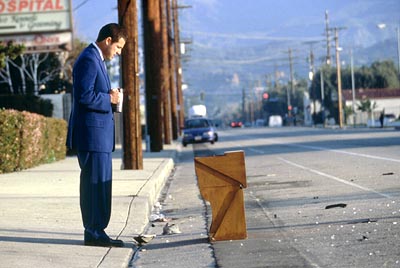
Marcy’s comment functions not a lot unlike the structure of After Hours itself. Where Marcy’s anecdote begins in horror and descends into banality, After Hours begins in banality and descends into chaos. And like Marcy’s speech, After Hours explores the cruelty of sex. It is a film in which its main character Paul Hackett sees sex as an opportunity to escape the boring routine of his life as a word processor, but in order to attain any he must venture into a strange section of New York City called SoHo, a world completely foreign to him. SoHo is a place that Ben Nyce, in his book Scorsese Up Close: A Study of the Films describes as, “A world where others accept deviant behavior with cool detachment” (88).
It is Paul’s naivety from which Scorsese derives both his comedy and drama as it stands in sharp contrast with this sexually deviant world where Paul quickly realizes that he is disgusted by the behaviors permeating the underbelly of SoHo and wishes simply to escape back home to his banal existence. What is most shocking about the film is that we as an audience exist on Paul’s side of the sexual coin: the straight man in a crooked world. This is how After Hours derives its blackness. By the time it is over and we have shared Paul’s grueling journey into the darkest realms of sexuality, we are drained. We, like Paul, just want to go home.
Maybe most disturbing and hilarious is After Hours’ outlook on the disgusting nature of sex. It is rare in any of Scorsese’s work for one to see sex as being synonymous with pleasure, but After Hours is particularly brutal in its depiction of the underside of the sexual conscious. We see this in one particularly funny scene in which Paul suspects that Marcy’s roommate Kiki has been robbed by a group of burglars. She drops him her apartment keys from her window which overlooks the streets below. He runs upstairs to find her tied up. He is impressed by the professionalism of the knots that bind her hands behind her back. A man cloaked in leather enters the room. Turns out Kiki was not burgled, but was simply engaged in a little friendly S&M. Again Scorsese has allowed the banal to descend into the obscure and the joke is on us, the innocent naïf.
However, for as  many jokes as the film makes about Paul, the sad sack of an outsider trying to escape this world of sexually deviant women, it is also unsettling in its treatment of said women. As Ben Nyce points out, “More disturbing and damaging is the films portrayal of women. As agents of Paul’s disorientation, Marcy, Julie, Gail and June are uniformly hurtful” (91). Even more to the point is the fact that Paul approaches all of these women as if they can provide him a portal of escape. Yet all of the women, mirroring the films perfect comic structure, appear normal upon introduction but descend into beings who only desire to entrap Paul, both literally and metaphorically. What the black comedy givith with one hand he takith away with the other.
And yet, despite this bleak content, there is something strangely funny about Paul’s Kakfaesque journey through the streets of SoHo. Because he is so innocent, so naive, so out of place in this strange world, we must laugh at the absurdity of his situation. Take the pathetic line the timid Paul uses in order to escape Marcy after becoming disgusted by the idea of sex, as he projects all of his sexual insecurities upon her once the possibility arises that she could be horribly burned enters into the scenario. He asks her to show him one of the bagel and cream cheese paper weights that Kiki makes, “As we sit here chatting,” he says, “There are important papers flying rampant around my apartment because I don’t have anything to hold them down with” (Minion, 1985). Not only does Paul not know how to deal with Marcy as a sex object, but once it arises that her sex is undesirable to him, he doesn’t know how to handle that either. He is, after all, a long way from his home as a word processor.
Or yet another perfect scene which balances sexual obscurity with hilarity in which Marcy explains that her husband was so fascinated by the Wizard of Oz that he only called her Dorothy in bed. Once again, sex is a hotbed for obscurity and deviancy instead of pleasure. Sex is not escape in After Hours, it is entrapment.
After Hours, at its comic center, operates as a juggling act, constantly presenting us with one thing and then ripping the rug out to show us something else more disturbing and perverse. This is, the very essence of what makes it a black comedy.
This process may not be clearer than in a final scene in which Paul meets a lonel y lady at a bar; the most seemingly normal he has met all night. They have a sweet moment on the dance floor in which genuine emotion seems to circulate back and forth between them, she hides Paul in her apartment from an angry mob that wants him dead, and we think that he has finally found someone who can truly help him. She then, in order to hide him, makes him into a paper machete statue, thus making him her own private prisoner. What the film makes us question in these moments is in the true tradition of black comedy: do we laugh at the absurdity of Paul’s situation or do we feel bad that he has been forced to realize the irony that sex is just as entrapping as his 9-to-5 desk job? Are we disgusted by the film’s inherent misogyny or amused by its audacious sexual deviance? The film, like all great black comedies, does not answer these questions, and nicely paves the way for true unrelenting filmmakers like Neil Labute and Todd Solondz.
 Women. Nice ones, the most frigid of the race, it doesn't matter in the end. Inside they're all the same meat and gristle and hatred just simmering.- Chad, In The Company of Men
If After Hours is a film about how devious women entrap men, In the Company of Men is a film that takes revenge with gleeful abandon. Written and directed by Neil Labute, In the Company of Men is a savage look at misogyny within the corporate world. The film tackles serious issues with cold detachment, and if it is a comedy, our laughter stems from a disbelief in just how brutal it is willing to be. It thus employs humor for two purposes: first as a coping mechanism and second, in order to sideswipe us by not allowing us to realize the true extent of main character Chad’s cruelty.
Neil Labute seems to make films about a specific kind of individual. His characters come from a place of position, they are the elite. Labute deals with people of status, be they corporate players, university professors or art students. Because of this, Labute easily projects his anger upon these people. He brings to the surface their shallowness, their greed, their hollow existences, their lack of a moral center; attacking them simply by showing us who they truly are. The comedy of Neil Labute seems to stem from a deep disgust and disdain for his main characters.
In this, the tru e spirit of black comedy, there is an inherent sadness that lurks underneath the scenes of humor. Labute sees Chad as a product of his own environment, a man who has been socialized into crushing everyone in the way of his path to the top of the corporate ladder. He and his friend Howard are constantly framed by office doors and windows, the camera never moving; they are trapped within the confines of their own corporate world with little room to move. If there is humor in any of this it is in the fact that one man could be so evil and yet so outside of caricature. We laugh at Chad out of fear; a fear that a man like him could actually exist among us.
Chad is thus a corporate slime ball whose plan is for him and the meek Howard to make an innocent deaf girl fall in love with both of them and then ditch her when she least expects. In a scene of utter cruelty, Chad describes with complete exaggeration to his co-workers how the mute girl Christine sounds when she talks. He laughs emotionlessly while comparing her to a dolphin, as she struggles to form words, spit gathering at the sides of her mouth. And yet the scene is funny; funny to think that any human being could be so cruel and unsympathetic; Chad is such a monster that we don’t know how to deal with his extreme behavior other than to assume he must be putting us on. The laugh therefore seems to erupt from a place of confusion; not because we are enjoying ourselves, but as a way of dealing with the underlying sadness of the scene; convincing ourselves that no one could possibly be so cruel by nature.
As stated prior, the second way in which Labute uses humor is to sideswipe the viewe r. Just like After Hours, In the Company of Men makes us think we are inside a comic universe only to pull the rug out from under us. Alas, Chad, in an act that uncovers the true unrestricted nature of his cruelty, not only destroys Christine but also Howard in the process, without care or concern. If In the Company of Men is so emotionally affecting, it is because the film steps outside of comic expectation and serves the audience with a cruel backhand to the face during the unexpected climatic moment.
Suzanne Fields states that “What makes the movie especially horrible is that the man who hatches the scheme and seduces the girl gets away without punishment. There’s no justice, poetic or otherwise, for his cruelty” (1998). By doing this, Labute has turned the black comedy upside down. In After Hours the comic tone, as critic Roger Ebert states, lets us know that “We’re not supposed to take it seriously” (1985). However Labute’s approach is more cynical, more real. Fields, explaining Labute’s purpose, says that, “He wants an audience to be deprived of the satisfaction of a moral resolution to make them-and us- experience the depths of moral callousness running amok in our society” (1998). In other words, Labute makes us believe that we have stepped into the comic world which is not to be taken seriously, a satire of the shallowness of corporate players, and then shows us that the situation is all too real by ripping the satire out from under us, leaving only shallowness, and showing that life is cold and cruel and that it is possible for evil to continue to exist without punishment. That Chad rises in status and position among his corporate cronies after his little stunt may be Labute’s cruelest joke of them all.

I want kids that love me as much as I hated my mother- Diane, Happiness
Todd Solondz is one of the most fascinating makers of black comedy. He is, in my opinion, the most unrelenting filmmaker working today because he is willing to bring modern taboos to the surface; dealing with them by having the courage to admit that they exist. His subject matter has ranged from childhood neglect, to rape, to pedophilia, to abortion, and yet, unlike Labute, who seems to have little but contempt for the inhabitants of his films and the society that created them, there is a strange, morbid sweetness lurking within the Solondz universe. He may be just as, if not more dark and relentless in his comedy than Labute, but he also sympathizes with the outsiders of his world.
A true auteur in the sense that his films are mirrors that reflect the state of mind of their maker: to understand Solondz’s films is to understand Solondz himself. In an interview with writer Sigrid Nunez from The Believer magazine Solondz says that,
When I want to show the kind of meanness people are capable of, to make it believable I find I have to tone it down. It’s in real life that people are over the top. And if I have a certain view of how people behave in this regard, it’s because I’ve been a target for a certain kind of comment all my life. Perfect strangers have always felt free to say things to me in the street, or shout things from passing cars (2005).
Alas, seeing that he is an outsider himself, we begin to understand why Solondz is attracted to the people who inhabit his films. Happiness is comprised of a suburban pedophile who rapes his son’s friends, a sex addict who combs the phone book looking for random women to make lewd phone calls to, a novelist who wishes she had been raped as a child so that her new novel could be more authentic, and a woman who has killed her doorman and placed his remains in plastic baggies in her freezer.
This is dark material, and even though Solondz doesn’t sympathize with the actions of the pedophile or the sex addict, he sympathizes with the individuals as human beings, which is what makes them funny. These are the people who live next door, who appear normal on the surface, the “quiet ones” as the neighbors always say; and although Solondz doesn’t go so far as to make excuses for the behavior of his characters, he does attempt to show that they are in fact normal, or at least in the sense that they too are human beings. There is something ever so sweet about a perfect scene in which Allen the sex addict and the woman across the hall who has recently murdered their doorman find each other and go to bed together, only to lie on top of the sheets, facing away from each other. Solondz is a master of allowing his characters exactly what they would want.
However, it is in the tradition of black comedy that the comedy works at the surface while darker subtexts hide underneath, and this is no expectation for Solondz with Happiness. Although he my align himself with the outsiders who he portrays in his films, there is still the inescapable reality that pedophilia is a serious crime and mental disorder, and for every scene of hilarity there is a moment of absolute bleakness such as the one in which Billy confronts his father about his pedophilia, resulting in a perfectly written scene which is also one of the most uncomfortable and heartbreaking ever to be put on film.
Herein lies the trick to Solondz’s brilliance. He leads us by the hand into situations that we don’t want to be in and then abandons us there, leaving it up to the viewer to interpret how we feel about a given situation. We laugh at a character’s actions and then analyze our own sincerity; do we feel right about ourselves having laughed about rape, pedophilia or abortion? Therefore, Todd Solondz is probably the master of the black comedy (a term he himself hates).
Where Scorsese amplifies his comedy into a state of nightmarish weirdness which could only exist in a world of its own, or at least New York, and Labute only provides us with the option of sharing his distain for his characters, Solondz is a fence sitter. He follows the rules of the black comedy, viewing sex as a function for displeasure, seeing the world from an outsider’s perspective, and making us  question how we feel about what we have seen, but he also offers no easy answers or conclusions.
Instead he presents the audience with only indifference, seeing the pedophile, sex addict, and murderer as both people who perform horrible actions and also have a human side, forcing us to look inside of ourselves and assess how we feel about the characters and their behavior based on our own moral judgments. In a sense, although all three directors discussed have either played within the realm of black comedy (Scorsese) or built a career out of it (Labute), it is Solondz, with his complete indifference, pulls the rug out from under us himself, which, despite the hilarity of his films, makes us wonder if he is even operating within the genre of comedy, black or otherwise, at all. No wonder he hates the term.