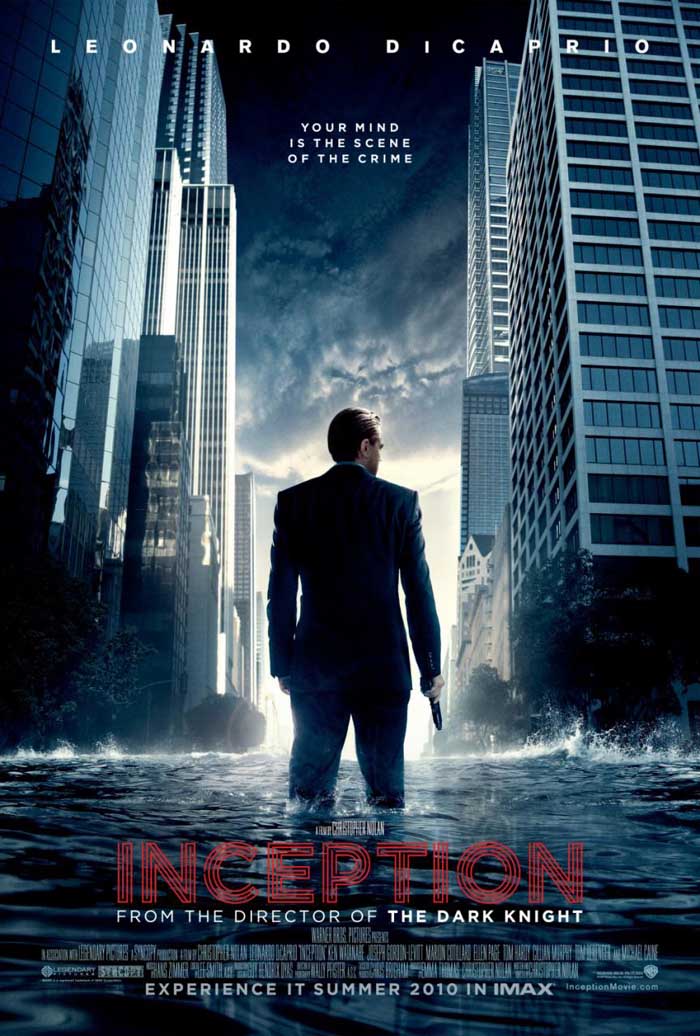
 Inception is best appreciated as an action movie. That is, after all, what it is. Sure it’s so complex that it folds in and upon itself time and again, it chews on endless psychobabble about dreams and unconscious’ and how reality and dream can overlap and be mistaken and replace each other and, on top of all that, it swims with all of director Christopher Nolan’s thematic stand-bys: Freud, Darwin, Jung. But really what it does first and foremost is satisfy Godard’s inkling that you only need two things to make a movie: a girl and a gun. In terms of girls and guns, Inception's just about got ‘em all beat.
Although the plot is complex by definition and trying to explain its every nuance here would be a near impossibility the concept is relatively simple: Inception is almost the exact same movie as Nolan’s The Prestige except, instead of a trick within a trick within a trick it deals with a dream within a dream within a dream. I guess Renoir was right when he said that filmmakers are destined to make the same film over and over again. Think about it: both films are about men driven to extremes by the death of the women they love, both deal in threes, both characters exist in worlds where fiction and reality are easily confused, both feature men who are consumed by the unreal, both are about extracting secret information from a nemesis and both end on the same ambiguous thematic note. This time there’s just more boom boom along the way.
So anyway, here goes: Leonard Dicaprio plays Cobb a man who uses futuristic technology to build dream worlds for his enemies, go into them and steal secret information from them while they don’t know that in reality, they are somewhere dreaming. The dream can, as we are show in the confounding opening sequence that throws us headlong into the plot, can exist on multiple levels of consciousness in which the dreamer can be taken into another dream.
Cobb used to be a great architect until the death of his wife, which forced him to flee the country, who keeps appearing in the dreams because he can’t let her go. It’s possible, you see, for a person in the dream to reflect their own subconscious memories and so therefore Cobb hires Airadne (Ellen Page) to build the dream worlds for him because, if he doesn’t know the layout, it will be harder for Moll (Marian Cotillard) to find them when they are in the process of an excavation and ruin everything.
The newest job is risky because it involves not extraction but inception: going into a persons head and planting an idea, which will grow into a reality and consume their life. This is to help businessman Saito (Ken Wantanabe) take over his competition. The mechanics of the plot can be, from here on in, left up to the viewer to discover.
What’s incredible about Inception is what an assured big budget filmmaker Christopher Nolan has become. Inception is the kind of film every filmmaker dreams of making but only gets the chance to after they’ve broken half a billion at the box office or won an Oscar. It’s a deeply personal, affecting film, filled to the brim with intelligence and interesting ideas. There was once a time when movies were based on original concepts and made by great filmmakers who not only knew how to entertain, but trusted the audience enough not only to be able to follow along but want to. Avatar was such a film last year. Now Inception is another.
However, like all personal films by filmmakers who have found the power to not be pushed around by studios, Inception isn’t perfect. Like Nolan’s monumental The Dark Knight, the story is most interesting after it gets on with setting up context and explaining itself. A lot of the dialogue that relates specifically to dreams sounds more like psychology 101 lectures than actual talk, but once the story gets in motion and feels comfortable rolling forward, it’s nothing short of big budget, edge-of-your-seat excitement that is second to none.
However, like all personal films by filmmakers who have found the power to not be pushed around by studios, Inception isn’t perfect. Like Nolan’s monumental The Dark Knight, the story is most interesting after it gets on with setting up context and explaining itself. A lot of the dialogue that relates specifically to dreams sounds more like psychology 101 lectures than actual talk, but once the story gets in motion and feels comfortable rolling forward, it’s nothing short of big budget, edge-of-your-seat excitement that is second to none.
Nolan’s greatest asset as the architect of this story is in his ability to juggle three or four levels of reality at the same time without confusing the plot and does a brilliant job of showing how, when something happens in one dream state, it affects what is going on in another, as is the case with the films very best sequence in a hallway corridor without gravity. It’s an action sequence for the books. Inception may not be the saviour of all cinema as some predicted it to be but it certainly is the best action movie out there right now. It may even be the best action movie since The Dark Knight. That’s no small feat.


