Showing posts with label The Prestige. Show all posts

Friday, July 23, 2010

Retro Review: The Prestige (5 out of 5)

If I learned anything from my little feud with Sam Juliano it is that one should never simply state their opinion without being prepared to back it up and argue it to the death. The majority of my posts this week have been on Inception since it is the hot topic but I've also mentioned how I think Inception doesn't compare to Christopher Nolan's best work, of which one of those titles in The Prestige. So I've decided to post my review from so many years ago.

The Prestige is about rival magicians who try and steal each others best tricks. I’ve always said that the greatest of horror and suspense film function like a great magic act: they distract us with the left hand while performing the trick with the right. By having The Prestige be about actual magicians, we can actually see how the art of suspense is rarely ever more complicated than this.

There are three acts to every magic trick tells Cutter (Michael Caine), a man who designs them. The first is the pledge in which a magician selects an ordinary object such as a bird or a person. The second is the turn, in which the magician does something extraordinary with the ordinary object, and the third is the prestige, because making something disappear is not enough, you must wow the audience by bringing it back. This last one is an interesting process because it diverts from the trick itself, which a magician must never give away.

The point of the prestige, it would seem, is to wow the audience into thinking something has happened which has not; something slightly outside of human possibility. By nature, humans search for complexities which do not exist and thus magic will forever feel slightly removed from reality. This is why a magician must never reveal his secrets. Once we understand how simple the explanations of most tricks are, they become possible and thus human. As long as magicians, and films for that matter, are able to fool us into thinking that something beyond our human capability has happened, we are dazzled

The story itself is about two magicians played by Hugh Jackman and Christian Bale. After the wife of Angier (Jackman) drowns during a trick because of Borden (Bale), the two men separate. This creates a bitter rivalry as both magicians try to exact their revenge and become the best in England, even if it means stealing the others most prized tricks.

The Prestige is not so much a battle of wits as much as it is a fascinating portrait of two men who will make any sacrifice for a Darwinian order which doesn’t seem to exist. There is no such thing as survival of the fittest in magic because no matter how many variations different magicians do of the same trick, the prestige is always the same, which is that the pledge returns to its original state of normalcy. Therefore, it is not the trick which makes the best magician, but how well he performs it.

Borden’s best trick is named the Transported Man and features himself stepping into a box on one side of the stage and exiting from one on the opposite side. Angier, filled with obsession, wants desperately to recreate this trick but can’t quite figure out how. After using a double doesn’t quite work, he goes to extreme lengths that are so theoretically fascinating that I dare not say another word about the plot.

That The Prestige is also a fantastic noir picture on the surface almost undermines the films true intelligence. The truth about magic is that, outside of magicians who give away their tricks, there is no proof that magic does or does not exist, or at least that it isn’t possible. What happens if it is possible for magic to become real through scientific evolution? But what if there is no such thing as magic? What if there is no such thing as science? These are all questions that the film so magnificently raises which lead to a final scene that is so tricky, so mysterious, so thought provoking, and so true to the physical art of magic itself that I wish I could discuss it, as I’m sure many will want to immediately after seeing it.

Even though the film is structured more or less exactly like a magic trick with its twists and turns, and unreliable narrators narrating unreliable flashbacks, the true dramatic heart of the film lies in the obsession inherent in both of these men to become something beyond magic, beyond human possibility. The film was directed by Christopher Nolan who also directed Memento, a film much praised by everyone who is not me. Nolan, through his four other films has become a master of tone and mood, constantly fascinated by the noir hero. Like the best noir heroes, these are men caught in complex situations who dive so far past the brink of obsession that they are no longer able to decipher what is real and what is simply a trick of the mind. In this sense, magic is the best place for Nolan to be exploring these themes; a place in which men must make sacrifices to a point where reality and fiction begin to seem interchangeable.

It’s hard to talk about a film as rich and complex as this one, without giving too much away. I will leave you with a small anecdote though. Recently my roommate expressed dislike for The Prestige, claiming that its secret could be given away with one word. This might be true from a narrative standpoint, but the fact is that suspense works through a process of negation: the simpler the explanation, the more complex the plot seems. This concept is not far removed from magic itself. One of the many structural treasures of The Prestige is its ability to trick the audience into thinking that much more is at stake than there actually is…or is there? Is this not the very essence of a great magical act? Is this not the very essence of great suspense as well?

Wednesday, July 21, 2010

Why Inception Didn't Save the Movies

Inception is not the savior of all cinema. It's a good movie. It's an even better action movie. But what else is it? Sure, as I stated in my five star review, it's intelligent and complex and we don't get that much in movies anymore, especially summer ones, but it kind of stops there. Maybe if people wouldn't have built it up as something to be compared to the second coming of Christ before they had even seen it than it would have had a deeper impact on me. When I'm looking for action and confronted with psychology, I'm intrigued. When I'm looking for psychology and confronted with action and fractured narrative, I'm entertained. See the difference?

In fact, Inception may be, now upon thinking about it, the most self-reflexive movie I can think of that forecasts its own shortcomings. Like it's hero Cobb it breaks it's own rules and becomes the victim of it's own psychobabble. One of Cobb's musings within the film is that an idea is like a parasite that is impossible to kill. It will simply latch onto the brain and grow until it has consumed the person's entire life. It's funny then that the film itself wouldn't heed its own ponderings. The film is, narratively speaking, ultimately rendered too mechanical because it focuses on an idea that seems to consume the every aspect of its telling.

The idea is that dreams can be entered and manipulated; that they have different layers and levels and such. The film's dialogue concentrates so heavily on talking about dreams and explaining different forms of dream logic, and discussing different waking mental states and philosophies about the nature between dream and reality and how it is possible for one to corrupt and consume the other, that by the time it is over we know everything about dreams but next to nothing about the characters in the film or what they are doing. As Jim Emerson and David Edlestein have rightly criticized, the entire film is more a narrative maze than an involving meditation of the division between dream and reality as Nolan's The Prestige was.

It's ironic then that this hasn't been a problem with past Nolan films. In his two best films The Dark Knight and The Prestige Nolan also created films about ideas and such but the difference was that the ideas were represented by the characters as opposed to the characters being at the service of the idea. Thus, to understand the idea was to understand the character. So when Nolan drew in ponderings on Darwinian order in The Prestige or created the Joker as a Freudian study in the uncanny in The Dark Knight, that was a way in order to help us understand the character while also dig deeper into the overall thematic elements that Nolan was exploring. The Joker was so scary because his ideas about society and chaos and evil were ultimately human and not that unbelievable either, thus we understood the psychology oh his character on a human level and could relate to him as such. But once we understand the nature of dreams in Inception, what are we left with but a bunch of masterful action sequences and a trick ending?

Interesting enough, Jim Emerson wrote yet another of his anti-Inception posts in which he beats an already dead horse to death again as is usual for him. However, he stars the article off with an interesting quote from Stephanie Zacharek that states, "If the career of Christopher Nolan is any indication, we've entered an era in which movies can no longer be great. They can only be awesome, which isn't nearly the same thing."

She's absolutely right, about Inception and Memento anyway. Inception is an awesome technical tour-de-force and that's what I awarded my five stars based on. As an action movie it's about as good as they come. However, as the saviour of cinema, Inception is a false prophet.

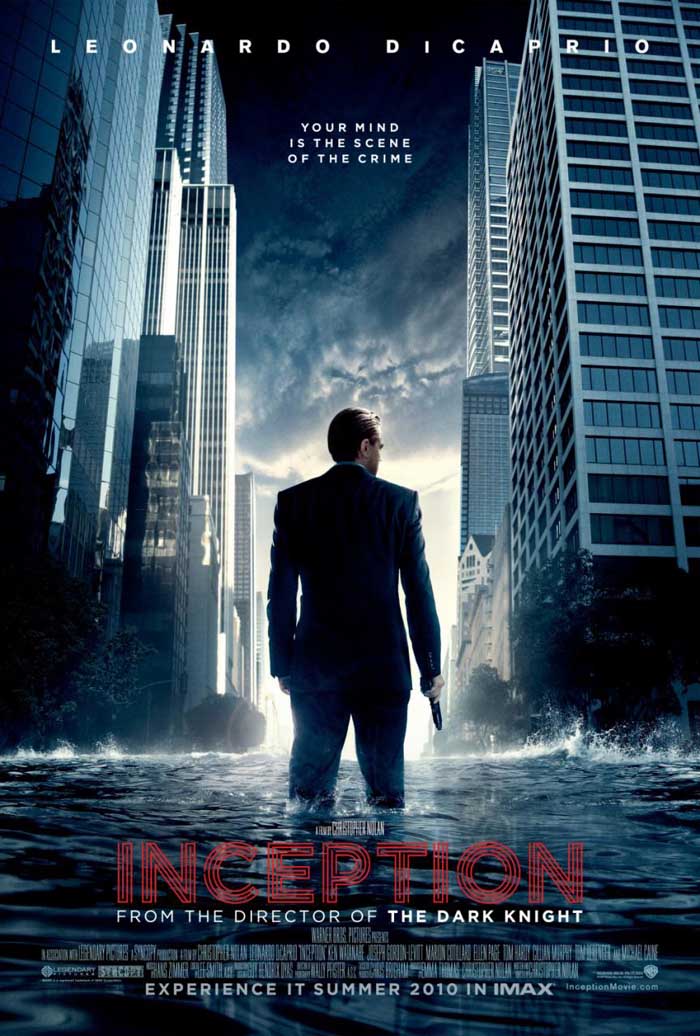
Inception (5 out of 5)

Inception is best appreciated as an action movie. That is, after all, what it is. Sure it’s so complex that it folds in and upon itself time and again, it chews on endless psychobabble about dreams and unconscious’ and how reality and dream can overlap and be mistaken and replace each other and, on top of all that, it swims with all of director Christopher Nolan’s thematic stand-bys: Freud, Darwin, Jung. But really what it does first and foremost is satisfy Godard’s inkling that you only need two things to make a movie: a girl and a gun. In terms of girls and guns, Inception's just about got ‘em all beat.

Although the plot is complex by definition and trying to explain its every nuance here would be a near impossibility the concept is relatively simple: Inception is almost the exact same movie as Nolan’s The Prestige except, instead of a trick within a trick within a trick it deals with a dream within a dream within a dream. I guess Renoir was right when he said that filmmakers are destined to make the same film over and over again. Think about it: both films are about men driven to extremes by the death of the women they love, both deal in threes, both characters exist in worlds where fiction and reality are easily confused, both feature men who are consumed by the unreal, both are about extracting secret information from a nemesis and both end on the same ambiguous thematic note. This time there’s just more boom boom along the way.

So anyway, here goes: Leonard Dicaprio plays Cobb a man who uses futuristic technology to build dream worlds for his enemies, go into them and steal secret information from them while they don’t know that in reality, they are somewhere dreaming. The dream can, as we are show in the confounding opening sequence that throws us headlong into the plot, can exist on multiple levels of consciousness in which the dreamer can be taken into another dream.

Cobb used to be a great architect until the death of his wife, which forced him to flee the country, who keeps appearing in the dreams because he can’t let her go. It’s possible, you see, for a person in the dream to reflect their own subconscious memories and so therefore Cobb hires Airadne (Ellen Page) to build the dream worlds for him because, if he doesn’t know the layout, it will be harder for Moll (Marian Cotillard) to find them when they are in the process of an excavation and ruin everything.

The newest job is risky because it involves not extraction but inception: going into a persons head and planting an idea, which will grow into a reality and consume their life. This is to help businessman Saito (Ken Wantanabe) take over his competition. The mechanics of the plot can be, from here on in, left up to the viewer to discover.

What’s incredible about Inception is what an assured big budget filmmaker Christopher Nolan has become. Inception is the kind of film every filmmaker dreams of making but only gets the chance to after they’ve broken half a billion at the box office or won an Oscar. It’s a deeply personal, affecting film, filled to the brim with intelligence and interesting ideas. There was once a time when movies were based on original concepts and made by great filmmakers who not only knew how to entertain, but trusted the audience enough not only to be able to follow along but want to. Avatar was such a film last year. Now Inception is another.

However, like all personal films by filmmakers who have found the power to not be pushed around by studios, Inception isn’t perfect. Like Nolan’s monumental The Dark Knight, the story is most interesting after it gets on with setting up context and explaining itself. A lot of the dialogue that relates specifically to dreams sounds more like psychology 101 lectures than actual talk, but once the story gets in motion and feels comfortable rolling forward, it’s nothing short of big budget, edge-of-your-seat excitement that is second to none.

Nolan’s greatest asset as the architect of this story is in his ability to juggle three or four levels of reality at the same time without confusing the plot and does a brilliant job of showing how, when something happens in one dream state, it affects what is going on in another, as is the case with the films very best sequence in a hallway corridor without gravity. It’s an action sequence for the books. Inception may not be the saviour of all cinema as some predicted it to be but it certainly is the best action movie out there right now. It may even be the best action movie since The Dark Knight. That’s no small feat.