Joel Axler, the co-founded of popular Canadian comedy club Yuk Yuks once told me that the entertainment business is a great one to be in but you need to be prepared to deal with a lot of death. He told me he would cringe every time owner Mark Breslin would call him for fear that it would be news of another death.
I suppose most people have heard of Corey Haim's death by drug overdose by now. He was 38. Haim was an iconic teen star of the 80s who, along with constant collaborator Corey Feldman, who also struggled with drug addiction, made some likable if wholly forgettable films. Haim had been out of the spotlight for a while, being most recently seen in the A&E reality show Two Corey's, which, not surprisingly, I never watched. I'm not really affected or surprised by news of this death, Haim has been out of the spotlight for too long to get nostalgic over and unlike John Hughes, who's work also dominated the 80s, his films have not aged into memorable classics. Still it is always sad to hear of the death of someone much before their time. It seems that these celebrity deaths happen in groups of three. A couple years ago it was Brad Renfro followed by Heath Ledger and Anthony Minghella. This year it has been Brittany Murphy and now Haim. Who will be the third?
In other depressing, albeit more ironic news, the LA Times is reporting that someone was stabbed in the neck during a screening of Shutter Island, a film about an institution for the criminally insane, at the Lancaster Cinemark 22. The story goes that the man was upset by a woman seated close to him who was talking on her cellphone during the film. When he confronted her she left with two other men who returned several minutes later and stabbed him in the neck with a mean thermometer. No word is given on the man's condition except that his wounds are serious and the suspects have not been found. Yikes, what is the world coming to when it's not even safe to go to the theater anymore?
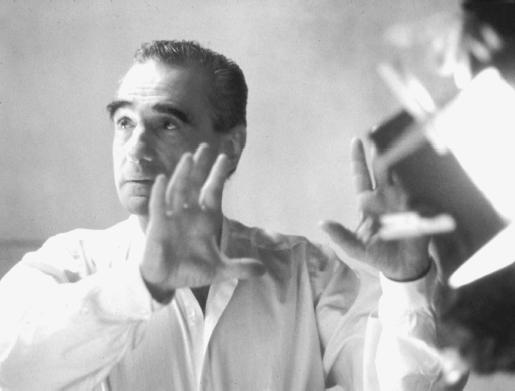
There are two director's working today who, above all others, have managed to rise above just being great filmmakers and into the realms of pop culture phenomenons. One is Quintin Tarantino and the other is Martin Scrosese. The problem with great filmmakers reaching this status though is that hordes of viewers flock to their movies for no better reason than because everything attached to their name must be brilliant by default. This isn't based on any critical logic, any in-depth thought or any knowledge about the trajectory of the filmmaker's career; it's just generally accepted pop culture wisdom that has been passed down through the generations. I know hundreds of people who think Pulp Fiction and Goodfellas are masterpieces, and they are, but I can count on one hand roughly how many people have been able to provide a decent explanation as to why this is the case.
Therefore kids, and adults too, will go to these movies and declare them masterpieces because well, isn't that what Tarantino and Scorsese do: make masterpieces, as if they have exceeded mere morality and are instead a brand name known for quality every time. And, in fact, they are known for quality. I've only seen one Scrosese movie I didn't like (The Colour of Money) and two Tarantino movies I didn't like (Reservoir Dogs and Death Proof), but I could sit down and conduct a conversation or debate, justifying my loves and disappointments for every film each director has helmed. After seeing Inglourious Basterds in August I went to the McDonald's across the street from the theater to get a McFlurry when some kid I knew vaguely from high school, who had apparently also seen the movie, explained to his friends with vigour all the ins and outs of Tarantino's oeuvre without ever once saying anything useful about the aesthetic texture of his films, the brilliance of their construction, the subtlety of using dialogue to create the kind of drama that no physical representation could, and so on. Every time I hear conversations going on like this I think feel like interrupting and saying, "Hey kid, Tarantino is more than just hip dialogue and references to other films." And then I think of French critic Pierre Rissient who said that 'It is not enough to like a film. Oe must like it for the right reasons."
I'm not trying to be some sort of film snob here, but what Rissient says is true: it's not enough to like films because the vast majority of their viewers have deemed them good. You have to have a justifiable reason, otherwise, your opinion is a moot point that is being set up to be knocked down. That's why bad films like The Usual Suspects, The Boondock Saints and Fight Club have gotten so popular: a lot of people started to say they were good simply because they were different until the point where it would be considered taboo to cast a bad word against them (see my reconsideration of Donnie Darkoto see what I am talking about).
But now I have gotten off topic because those kids are talking about movies they liked. I'm talking about good movies: movies where you can see a masterful director making the best out of what they have been given. I'm talking about appreciating good lighting and editing and camera angles; all that stuff that lead to a films overall style. Too often people confuse movies they like with movies that are good. Anyone can express if they likeed something to some sort of extent, but few people have the knowledge to judge whether a film is actually good or not.
That finally brings me to Martin Scorsese's Shutter Island which is the kind of film that really tests Scorsese's (or any great filmmaker's) audience and separates the film "viewers" from the film "watchers." I say this because as I was watching Shutter Island, someone in the back of the theater was laughing as each new revelation of the story was revealed, clearly so disgusted with the path the story had taken that he just had to laugh at the ridiculousness of it all. Then, after the screening, I heard some teenage girl declare it the "gayest" movie she had ever seen. Really, I thought, these are the people who go to see Scrosese's movies?
But you see, Shutter Island is a good movie. It's actually a masterpiece if you don't take the story into consideration. It's a masterpiece in film style, perfectly evoking a long forgotten time and genre of filmmaking. Scorsese flawlessly evokes the look and feel of the 50s film noir and uses that as a grounds to create the suspense of horror of the story. How does it do it? Well how about the brilliant overhead lighting, casting long shadows up walls and across floors, the shot that begins as a close up of Leonardo DiCaprio's face until pulling up to reveal the vastness of a cliff side lurking just behind him, one wrong move leading to death. Then there's my favourite shot in the movie. It takes place in Ward C and is an overhead shot on a low angle that shows a maze of steel stairs and corridors hitning that the story starting to come apart by perfectly representing the main character's state of mind: cold, dark, confused, and going in an endless tangle of directions all at once. The examples could go on for days.
That's great filmmaking. If the story isn't up to Scrosese's standards, well at least he still brought his A-game to the table. That's the problem with Scrosese as a pop culture icon: everyone can see the brilliance of the tracking shot in Goodfellas because tracking shots are big and obvious and draw attention to themselves, but when Scrosese goes subtle, pays homage to a past film genre, creates for his film the style it deserves and not the one that announces itself as film style, the movie is passed off or thrown away, as if it never occurred to these people to ask why Scrosese is considered, after all, one of America's best living filmmakers in the first place, because, believe it or not, there is a justifiable reason. It's the job (and the fun) of movie lovers to figure it out.
The Oscars are over. What will Nataniel R write about now over at Film Experience considering he was averaging around an ungodly 3-5 Oscars posts a day? So what did I think of the Oscars? They were okay. Some things worked, some didn't. There was a lack of drama except for one interrupted acceptance speech for best short documentary. That said, I just wanted to share a couple of random observations I made throughout the night.
Steven Martin and Alec Baldwin are funny guys. Hopefully though, if there is ever a pair of hosts again they can have dialogue that sounds more like a routine and not an improv at Second City. The picture of them backstage in a couple's Snuggie was a huge laugh though, as was Martin's comments about writing Geoffrey Fletcher's speech.
Not only was Neil Patrick Harris' opening song completely unglamourous and mostly unfunny, but what was with the lighting in the audience? The camera was cutting to people in the darkness as he was singing about them.
Robert Downey Jr. could make a funeral funny. Best presenter of the night.
Sean Penn managed to go the whole night without kicking or punching anyone but still couldn't manage a coherent introduction to the Best Actress nominees. *Update* I haven't even published this post and I'm eating my own words.
Jeff Bridges is a rare kind of star: he dedicated his Best Actor award to his late parents, he's been in a marriage for over 30 years, he's acting has never been undermined, to my knowledge, by any personal drama and he's a heck of a great actor on top of it. Did his speech ramble on? Sure it did, but he deserved the moment.
Tyler Perry: "I'm on stage at the Oscars. I better make the most of it because it probably won't happen again." My thoughts exactly.
I don't know what's worse, a pointless montage paying homage to horror films or the fact that it included scenes from Twilight. And to think, this is why no original songs were performed.
Although it was an impressive display of physical acrobatics, Mad Hatter said it: if I wanted to watch America's Next Dance Crew, I could have changed the channel to it. I think it's safe to say we can thank Adam Shankman for that number.
Precious won Best Adapted Screenplay. I picked Up in the Air to win. I guess I learned a valuable lesson: don't pick the better film to win because it probably won't.
Mo'Nique's acceptance speech was one of the best and most heartfelt. She thanked Hatti McDaniel, the first black actress to win an award for Gone With the Wind, for going through when she had to go through so she wouldn't have to. Back then awards were given out during dinner and McDaniel was forced to sit at a table by herself.
I don't know if she deserved to win or not, but Sandra Bullock's speech was good too.
Thinking about Best Actress, Oprah almost had me sold on Gabby Sidibe and then I realized that she probably won't have much of a career after Precious because, not to sound course or anything but, she's can't really play anything but fat black girls.
Did you see that moment before she read the winner when Barbara Streisand said "It's finally happened," giving Lee Daniels just one second of hope?
Kathryn Bigelow is 58 and still looks better than most of the young stars in attendance. Good for her. Also nice to see her take home the big awards as she hasn't exactly been the kind of filmmaker you'd expect to make award winning films in the past.
I was strangely unmoved by the John Hughes tribute. The montage of his work was weak and, outside of Planes, Trains, and Automobiles and Sixteen Candles I've never found his work anything more than simply entertaining and this tribute didn't do anything to change my mind about him, or his deserving a separate honour all to himself
Speaking of honouring late celebrities: where the hell was Farah Fawcett in the montage?
Ben Stiller bounced back this year after his tasteless parody of Joaquin Phoenix last year. He played the Avatar get-up perfectly, as a man who looked like a jackass and knew it. That said, where was all the other big comic talent like Will Farrell and Jack Black? Did Shankman sacrifice them for Taylor Lautner and Kristien Stewart?
Next year, how about going back to five Best Picture nominations? That's all anyone really needs.
Why is Pedro Almodovarintroducing a category that he clearly deserved to be nominated in?
Speaking of Best Foreign Film: do voters just pull names out of a hat for this category? Remember a few years ago when Pan's Labyrinth won every award it was nominated for except Best Foreign Film? I think Almodovar got the shaft that year too.
While we are on this topic: why does Quintin Tarantino feel the need to start yelling into the mic at every awards show? He did it at the Grammys and now he has done it here too.
I long for a year when Jason Reitman will actually be the frontrunner. He really deserves some wins.
I'll be glad when tonight is over because it will be the longest possible time until the blog world is bombarded with ceaseless posts about everything Oscars again. It's not that I blame people, we have to find our inspiration somewhere, but really, once you reach a certain point, there's only so much Oscar coverage one can take.
This doesn't mean that people out there who I respect didn't do a good job in their writing and it doesn't mean I didn't read it, I just didn't comment about it very much. That said, I recognize the ugly double standard that is going on here right now as I myself give my final word on the Oscars, which are happening, as probably everyone knows, tonight.
That said, if you don't want to read this or put too much thought into it, well, I don't blame you, but I haven't written much this past week and figure I might as well cap it off with something now that I'm back in Toronto. And, if nothing less, maybe you'll just read it because you like me and find my style somewhat entertaining and want to know how good I am at this whole political voting thing. Hey, it's a possibility. So I won't prolong it anymore: here's my predictions on who will win tonight, who should win, and anything else that comes to mind.
Best Documentary: The Cove will win because it has the most prolific reputation amongst the nominees. It's that simple really, although Food Inc. may have a shot too.
Best Foreign Film: The White Ribbon because it took the Golden Globe and the Golden Palm at Cannes, plus it's the only one of the nominees I've heard of so that has to count for something, no?
Best Animation: I'll say this: Disney is taking home a prize in this category tonight. What I'm curious about though is whether or not Up's place in the Best Picture category will mean a split vote for the film and The Princess and the Frog will take it? Oscar certainly does love a comeback and Dinsey's first 2D animated feature since Home on the Range certainly falls into that category, even if it didn't do quite the business it should have. My vote's still on Up though. Pixar just seems too unstoppable.
Beat Visual Effects: Avatar. Duh.
Best Original Song: Crazy Heart's got this one covered. When a film has more than one song nominated it tends to split the vote, as is the case with Princess and the Frog;Nine was uninspired and Crazy Heart took the Golden Globe award. Personally though, I prefer Flyin' and Fallin' from Crazy Heart, but that's just me.
Best Adapted Screenplay: A tough category. I'm going to eliminate District 9, An Education and In the Loop right away. It seems to be an even draw between Precious and Up in the Air. Precious has the advantage in that it pretentiously announces that it is based on a book right in it's full title, which I refuse to type out in whole, but Up in the Air is the better film, so I'll vote for it.
Best Original Screenplay: It's unfortunate that Inglourious Basterds came out in a year of hugely prolific films because, on any other year it would have been a no-brainer to give it this award. I'd still like to see Tarantino go home with this one. He is, after all, the best writer of all those nominated. I think it will probably go to The Hurt Locker out of default though. Inglourious Basterds doesn't seem like it will win anything else in the major categories except best supprting actor, which means it doesn't really have much of a shot here either.
Best Director: I know Kathryn Bigelow is going to win unless the Academy goes against the Director Guild by not picking the same winner, but that rarely happens. In theory though, the best choice would be Lee Daniels. Not because Precious has the best direction (and really, does Daniels really need anything to increase his already pompously sized ego?), but because the Academy is sometimes accused of trying to atone for their past mistakes (Paul Giamatti is nominated for Cinderella Man after being overlooked for Sideways, etc.). This then reminds me of several years back in which the Academy were deemed homophobic for letting Crash win Best Picture over Brokeback Mountain (people seem to have forgotten though that they gave Phillip Seymour Hoffman the acting trophy for playing an openly gay man in Capote that same year). I also assume that if Brokeback Mountain had won people would have cried that the Academy is racist too. How better to atone for this than giving the award to a gay, black director? It's just a thought.
Supporting Actress: Mo'Nique. Don't argue, just accept the inevitable.
Supporting Actor: Christoph Waltz. See above.
Best Actress: A lot of people are rooting for Merly Streep, but I don't know, her performance as Julia Child came off more as imitation to me than actual acting. It also doesn't help that Julie and Julia was a wholly uninspired film. Therefore I'm voting for Sandra Bullock. We'll forget All About Steve and say that 2009 was a huge comeback year for Bullock and we all know Oscar loves a comeback.
Best Actor: It seems like Jeff Bridges is the forerunner in this category for Crazy Heart and his performance certainly does deserve the award. However, Oscar is sometimes know for pulling some fast ones in this category (Alan Arkin over Eddie Murphy, Sean Penn over Mickey Rourke), so could the award maybe go to Morgan Freeman as Nelson Mandela in Invictus? I haven't seen the film myself so I can't comment on the quality of the performance, but Freeman is the only nominee who played a real-life character and Oscar history dictates that the Academy seems to favour actors who play real people. My vote's still on Bridges though.
Best Picture: It's between Avatarand The Hurt Locker. I'm going with Avatar. It made billions of dollars, revolutionized film technology and The Hurt Locker may have shot itself in the foot over the controversy caused by it's producer writing stupid letters basically begging Academy members for votes. Also, considering how Oscar seems to be going for viewers this year instead of prestige, Avatar is the best bet.
With that out of the way I hope everyone enjoys the show and (partially) hope Tarantino can refrain from spitting on people during the red carpet. It still irks me that John Hughes will be getting his own tribute when Patrick Swayze and Eric Rohmer will simply be limited to getting their picture in a montage. Oh well, I'll live, I think.
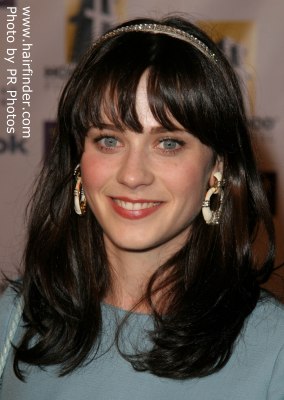
The past three times I have done this has been purely in jest (although I'm still holding out that Michael Bolton and Michael Bay are the same guy). This time I've found an honest-to-goodness resemblance that is so uncanny that if you told me they were the same person and I didn't know any better I'd believe you. A lot of people say ZooeyDeschanel looks a lot like Katy Perry. They're not even close:
Could ZooeyDeschanel really be Debra Winger in disguise? You Decide.
The boat rolls out of a fog so dense that it renders everything a brilliant white. It might as well be sailing straight out of 50s film noir. Aboard it U.S. Marshall Teddy Daniels vomits violently in the washroom. This is a man who has not repented for the sins of his past and carries that burden atop his every move. As an agent he looks the part: tan suit, sharp hat; the whole nine. As played by Leonardo DiCaprio he’s a seasoned professional: been too many places to be much surprised anymore and seen too many things to much care, and yet he carries hidden secrets in the way he holds his shoulders and hangs his head. To him, this new case at the state run mental hospital for the criminally insane will be an in-and-out job but his partner Chuck knows better, “If these guys only heard voices and chased butterflies they wouldn’t need us.”
The men are escorted to an entrance gate, surrounded by looming brick walls and guarded by emotionless men with big guns. They are instructed to hand over their weapons because, as a state run facility, it is the law that the guards carry rank over the cops. They’ll play by their rules or not play at all. While a storm brews outside they are lead to Dr. Cawley, the man in charge. He is played by Ben Kingsley which means he is proper, well-spoken and pristinely mannered, while also managing to give the feeling of always holding something back. It doesn’t help that his colleague at the institution is played by Max vonSydow who has made a career out of always holding back deep secrets that give off ominous tones.
That’s the set-up to Martin Scorsese’s Shutter Island, the director’s first excursion back into thriller territory since Cape Fear and his first into classic horror and film noir. Two Boston cops are sent to the isolated institution in order to track down an escaped patient that no one will admit to having seen escape or know exactly how she went about it. “It’s as if she just evaporated through the walls,” assesses Cawley, and he may be right; there seems to be a lot of spirits haunting the walls of Shudder Island, or at least the pain of their memories. The girl in question us Rachel, who drowned her three children and still, according to Dr. Cawley, has no idea what she has done or that she is even in an institution.
The grounds are divided into three buildings, a ward for the men, a ward for the women and Ward C, which used to be an old Civil War post and houses the most dangerous criminals. No one is allowed access to Ward C without the accompaniment of both Cowley and the warden.
As the investigation progresses Teddy is attacked by migraines and visions of his wife who was killed in a fire and to his days during World War II in which he saw dozens of men slaughtered without mercy in a concentration camp. As the investigation progresses and Teddy gets closer to uncovering the truth his inner demons take him closer and closer to the physiological breaking point. What about the institution that triggers these dark feelings in Teddy is one of its many secrets, of which I dare not continue to hint at.
This is a brilliant set-up for Martin Scorsese to evoke that golden period of classic horror and film noir, which consisted of wounded men carrying their emotional baggage around on their shoulders, drifting from one job to the next, always searching for some sort of inner redemption that is just out of reach. Here Scorsese once again proves himself the master of tones and moods, of implying more by showing less. Shutter Island is, if nothing more, a brilliant exercise in set design, lighting, costumes and editing. Every frame is meticulously constructed to convey the sinister undercurrents that could lie around every dark, damp corridor of the wards. Consider the way Scorsese slowly tracks the camera through desolate spaces in ominous point-of-view shots, how high angles reveal labyrinth mazes of unending stairs and corridors or how the camera cranes up from close-ups to reveal imminent danger lurking in the background. Not to mention Ward C, when Teddy finally gets there. It’s a virtual hell-on-earth that will go down as one of the great horror sequences of its time.
As a thriller, the first two thirds of Shutter Island are riveting and we eagerly anticipate what new tricks Scorsese has up his sleeve. And then, as most thrillers tend to do, the film loses touch in an effort to ceaselessly explain itself (a verbal description in the third act is followed by a flashback that visually depicts the exact same thing) and we’re left with another case of the explanation being much less than the buildup, leaving the sinking realization that the material has no intention of rising to the occasion that Scorsese and his actors have set for it, leaving Scorsese trying to pull rabbits out of empty hats.
And yet Scorsese’s brilliance as a filmmaker still stands outside of the story and keeps the wheels spinning. The filmmaker’s mastery of his craft oozes into every perfectly constructed shot and the film thus, even when stalling, feels like a work of art to be hung on the wall and pondered over the delicacy of its creation. As the greatest living filmmaker working in America, Shutter Island will not be remembered as Martin Scrosese’s best film. In lesser hands it wouldn’t even pass as a tolerable thriller and yet even as its plot crumbles down around it, as an evocation of a classic, long forgotten genre and all its moods, textures and surfaces, it is just about a perfect stylistic exercise.
It's Reading Week, or March Break, or Spring Break. Whatever you want to call it, I'm on it. Unfortunately, Reading Week means less in a post-graduate college degree program than it did in University, so I'm up to the eyeballs in projects that I have to get done. The moral of the story is that posts will be limited this week (though I'm seeing Shutter Island tomorrow so expect that review soon). I'll continue to log on and make comments on interesting things I find on other people's pages, just don't expect anything huge from this page this week.